AI Debate Judges vs Human Judges
October 26, 20269 min read1,934 words
Text: Share a Hot Take Editors
AI judges excel at consistent feedback for practice.
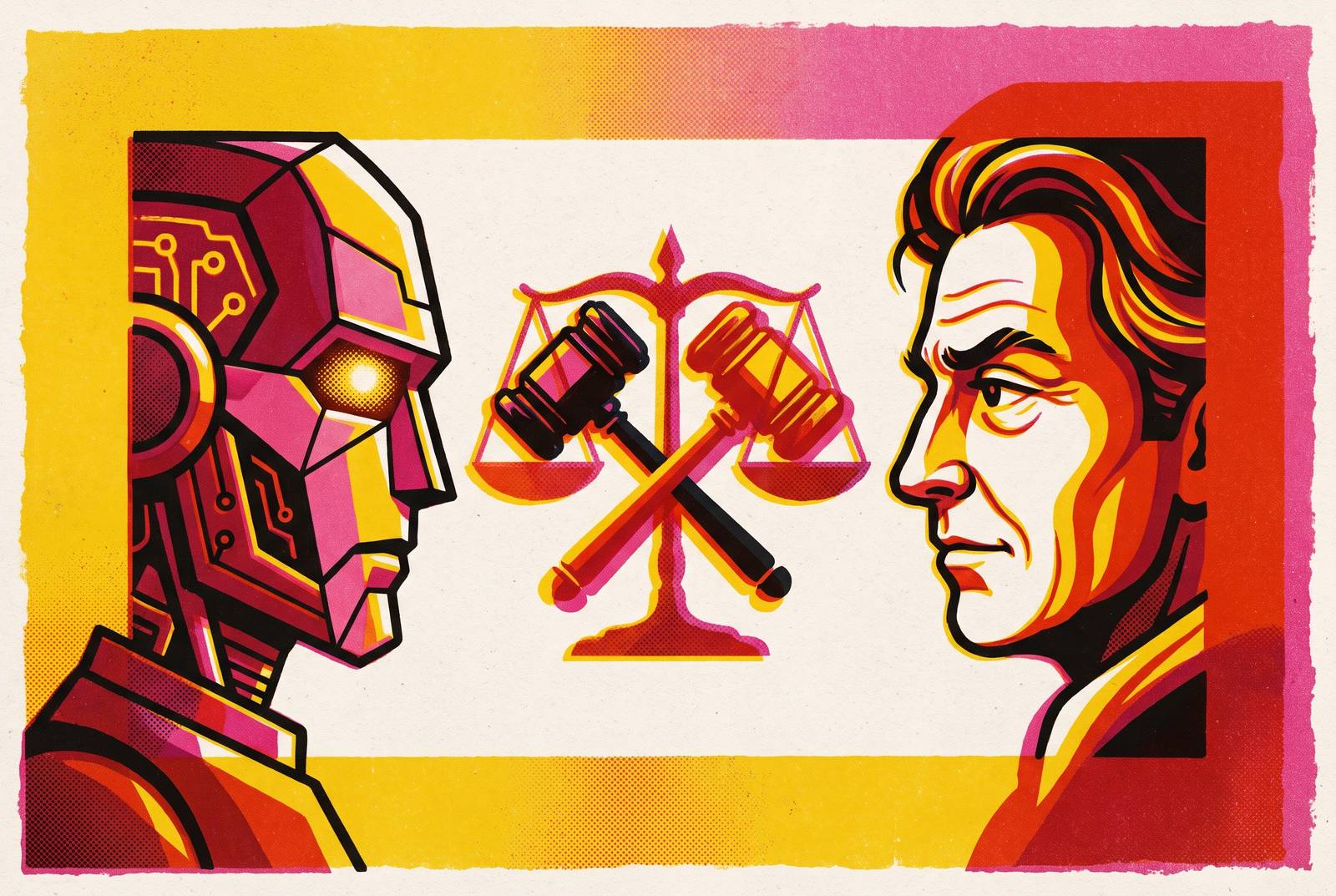
AI debate judges work best for repeated practice with consistent rubric-based feedback, while human judges are better for rounds where the outcome has consequences and judges must weigh the context and rethink their views as arguments unfold. For a live voice debate platform with AI judging and a published scoring rubric, the key distinction is whether debaters can inspect the criteria, understand the decision, and challenge an error. Automated scoring alone does not establish fairness.
Why the question of who judges a debate is not just procedural
The judge determines what counts as a good argument. That decision shapes preparation, coaching feedback, and the evidence a debater uses to assess progress. A speaker preparing for fixed scoring criteria faces a different task from one preparing for an evaluator who can recognize an unconventional strategy and revise an assessment during the exchange.
AI judging has expanded under pressures of speed and access. Automated results can arrive immediately, while human judging can require hours or days, and experienced judges are not equally available outside well-resourced programs. Yet the distinction between “consistent AI” and “biased humans” explains too little. Consistency is useful only in relation to what the system measures, while human discretion can either recognize an achievement or distort its evaluation.
What an AI judge actually does when it scores a round
A rubric-based AI judge evaluates a round against fixed criteria on a common scale. The rubric defines what earns credit, and the system can explain which criteria were met and why a point was credited or withheld. This gives evaluation a stable frame of reference. It does not, by itself, establish that every application of the criteria is correct, or that the criteria capture everything a skilled debater accomplished.
When the scoring rules are published before a round, debaters can examine that frame in advance. They can see what the evaluator is meant to reward rather than infer its preferences from previous decisions. The distinction is one of access to the standard. A written rubric makes the stated basis for judgment available to every participant, whereas much of a human judge’s interpretation remains implicit until the decision.
Platforms built for practice can also judge speech delivery, including pacing and filler words, along with the quality of the argument. This extends feedback beyond the annotations a tournament judge would ordinarily provide. It makes repeated practice useful at a finer level. A debater can receive feedback on how an argument was organized and delivered, rather than only whether the performance was sufficient to win.
What a human judge does that the rubric cannot capture
Human judgment adds interpretation that fixed criteria cannot fully encode. Sarcasm, irony, cultural reference, and the timing of an analogy can change the force of a speech without changing its formal structure. Context changes what the words are doing. A human judge can recognize that a speaker is deliberately playing devil’s advocate rather than treating the departure from a conventional position as confusion.
An aggressive delivery may register as confidence to a human judge while receiving a lower assessment from an AI evaluator. Each response shows how the judge weighs delivery and setting in deciding how persuasive a speech is, so judges who share a rubric can still read a speech differently.
The EMNLP 2025 study Benchmarking LLM Judges via Debate Speech Evaluation found that even the strongest LLM judges differed substantially from human judges in their overall judgment behavior. Models could agree with humans on relative rankings while diverging systematically in absolute scores, with AI models tending to score lower. Agreement on order is not agreement on quality. The finding cautions against treating an AI score as interchangeable with a human score, even when both evaluators prefer the same speech.
Where human judges reliably go wrong
The discretion that supports contextual understanding also permits irrelevant influences. Human judges experience fatigue and distraction, and a charismatic speaker can pull attention away from weaknesses in an argument. Their consistency varies across rounds as a result. These are structural vulnerabilities of people evaluating demanding exchanges.
Speaker likability, alignment with a judge’s prior beliefs, and emotional delivery can also influence an assessment independently of argument quality. The difficulty is separating legitimate rhetorical force from its distractions. A judge may properly recognize the purpose of an analogy while still giving too much weight to the confidence of the person delivering it. Human sensitivity to context is therefore not an unqualified advantage.
For debaters, this variability creates an additional preparation burden. Scouting a judge’s paradigm, topic familiarity, and stylistic preferences takes time that could otherwise go toward argument development. That work responds to a real feature of competition. The same argument may need different framing for a judge who favors technical refutation and one who responds more strongly to persuasive framing, even when the underlying evidence does not change.
The one area where AI judging has a documented structural limit
The most consequential limitation concerns updating an assessment through adversarial argument. A judge must do more than recognize a clear opening case or a well-formed rebuttal. The exchange can change what deserves to be believed. An evaluator needs to register when a challenge undermines a premise, when an answer repairs it, and when a speaker can no longer defend the position with which the round began.
Maria Victoria Carro and colleagues’ Humans Correct Their Judgments Through Debate, but Weaker AI Models Do Not found that human judges corrected their judgments through debate, while weaker AI models did not reliably do so. The study concerns debate as a means of AI oversight, with opposing AI systems presenting arguments to a human or weaker-model judge. Its scope is specific and should remain so. It shows a weakness in learning from adversarial argument, but gives no proof that every AI judge fails at every debate task.
That distinction challenges the equation of consistency with fairness. An evaluator could apply the same criteria repeatedly yet fail to revise an assessment when the exchange supplies a reason to do so. Stability would then preserve the wrong judgment. For competitive debate, the concern is that a system may reward the structure presented at the start without adequately crediting the later argument that forced an opponent into contradiction or retreat.
The same study identified a further risk in non-diverse deliberation panels. Minority judges could be swayed toward wrong positions that were framed more persuasively, and multi-AI-judge panels may make the same mistake. More judges do not automatically solve the problem. A panel’s value depends in part on whether its members keep their own judgments or let a persuasive presentation draw them into the same mistake.
For debaters, the implication is a limit on interpretation. An AI verdict can provide useful evidence about the dimensions it scores without settling whether the evaluator tracked the decisive change in the round. The research explains why a polished case and a successfully defended case cannot be assumed to receive different treatment from a judge that updates unreliably.
What each judge type is genuinely well-suited to do
AI judging works well for lots of practice on argument structure, clarity, and delivery because it gives feedback more often than human tournament judges can easily do for as many rounds or at the same cost. Repetition is the advantage in this setting. Debaters can work on the dimensions the rubric measures without making every practice round depend on an experienced judge’s availability.
That availability also makes AI judging a more equitable option for debaters outside well-resourced programs. A shared rubric and accessible decisions reduce differences created by access to human evaluators. A team can gain a great deal from frequent structured feedback and still need human judges to assess skills that the automated system does not reliably judge.
Human judging is better suited to competitive rounds where the outcome has consequences and the evaluator must follow a complex multi-speech exchange. It also remains essential when a format rewards stylistic creativity or unconventional argumentation that falls outside predefined criteria. In those settings, the capacity to interpret an unusual strategy and update through the exchange is part of the competence required to judge.
AI-judged practice can build habits that a rubric can measure, while human-judged rounds test whether those habits hold up when judges weigh the context and rethink their views during the debate. The division is based on the kind of evidence a debater needs at each stage of improvement.
What should a live voice debate platform show about its AI scoring?
A published scoring rubric gives debaters access to the standard, but useful transparency must extend to the verdict. The decision needs to cite what was actually said and explain why it earned credit or a penalty. Without a connection between the speech and the criteria, a debater cannot distinguish a weakness in performance from a weakness in evaluation.
A way to appeal the result adds a safeguard because seeing how a judge reached a decision does not by itself fix a mistake. Published criteria, speech-specific reasoning, and a way to contest the outcome address fairness more directly than an assurance of consistency. They make the verdict open to examination. A debater can assess whether the reasoning matches the exchange rather than accept the score solely because a system generated it.
A panel of independent AI models can support that examination when each model scores separately and produces a written explanation. Independent assessments reduce the risk that one model’s training-data bias determines the verdict and give the debater different lines of feedback to compare. Independence is the important condition in this arrangement. This differs from the non-diverse deliberation described earlier, where panel members can persuade one another to take a wrong position.
Transparency makes the basis of a decision available for scrutiny and challenge, while the documented limit on updating through argument remains. That changes what feedback can accomplish after a round. The relevant distinction is not simply whether a platform uses AI, but whether its output allows a debater to learn from a justified criticism and contest an unjustified one.
How to prepare differently depending on which judge type you will face
For AI-judged rounds, preparation should prioritize structural clarity and the published rubric. Debaters should clearly signpost arguments, answer opposing points directly and in order, and avoid relying on rhetorical devices that work only when the judge recognizes their form. Legibility should take priority over stylistic flair in this setting. When an opponent contradicts or abandons a position, the significance of that change should be restated explicitly.
Delivery should also match the register the rubric rewards. An aggressive or combative tone may be scored down even when a human judge would read it as confident and competitive. Direct refutation can remain forceful without depending on a tone that the evaluator may penalize.
To prepare for human-judged rounds, debaters should start with the judge’s paradigm. Debaters should establish whether the judge favors technical line-by-line refutation or persuasive framing and calibrate delivery to those preferences, including the competitive register many human judges favor. Debaters should spend just as much time preparing for the exchange itself. Forcing an opponent into a contradiction can change a human judge’s assessment in a way that an AI evaluator may not credit without an explicit structural explanation.
Across practice, the strongest approach uses AI-judged rounds to build argument structure, direct responses, and delivery, then human-judged rounds to test those habits under contextual evaluation. The two forms of feedback answer different questions. The practical skill is knowing whether a verdict identifies a repeatable weakness, reflects an evaluator’s preferences, or misses the point at which the debate changed.