The Introvert's Case for Solo Debate Practice Over Joining a Club
November 21, 20268 min read1,864 words
Text: Share a Hot Take Editors
Solo AI practice gives introverts the feedback loop clubs don't.
For people with no competitive background who do not want to join a club, solo AI debate practice offers a practical starting point when it combines adaptive opposition with scored, explained feedback. For introverts, it removes the scheduling, group dynamics, and public stumbling that can prevent regular practice. The case for starting solo rests on preserving the skill-building loop.
Why debate clubs structurally exclude the people most likely to benefit from debate practice
A club practice round requires coordination before it requires an argument. Someone must find a partner who is available, sufficiently matched in skill, and willing to practise. That negotiation recurs whenever another round is needed. For an introvert who already finds group participation costly, it becomes a recurring charge on the work of learning. The obstacle arrives before the practice can begin.
Uncertain phrasing, weak rebuttals, and lost threads appear before peers at precisely the stage when those weaknesses are most common. Club dynamics can also reward confidence before competence, quick social reading, and comfort asserting a position in front of others. Those advantages help people participate regardless of the soundness of their reasoning. A person who needs repeated attempts to construct a clear rebuttal must therefore navigate a second challenge while learning the first.
This makes clubs an uneven default for practice. Their structural costs fall differently on people who welcome public improvisation and people who would benefit from developing an argument before exposing it to a group. For the latter, joining can demand the very confidence that practice is supposed to build. The format creates a barrier even for people with the capacity to debate.
What actually produces debate improvement, and why solo practice can deliver it
Getting better at debate takes repeated attempts that make the debater think hard. Institutional membership is not the operative ingredient. A useful practice method must provide frequent opportunities to argue and opposition that exposes weaknesses in the reasoning actually offered. Ideally, that means practice daily or several times a week, independently of everyone's availability.
Coordination restricts opportunities, and partners at the same level can leave shared weaknesses untested and reinforce them. Yet removing the partner is not enough. A solo exercise must still require the debater to respond to resistance, going beyond recitation of a prepared case. Otherwise, repetition can make an argument familiar without making it stronger.
An adaptive opponent constructs responses to the argument presented, so the next move depends on what the debater actually said. A pre-scripted opponent offers predictable counterpoints that can eventually be learned and dismissed. Predictability drains the exercise of productive pressure. The standard is not whether a response sounds argumentative, but whether it requires fresh reasoning.
Scored feedback must give a round a verdict and an explanation of why one case prevailed, so the next attempt has a direction. Without that explanation, doing more rounds can hide mistakes that keep coming up. Any practice format should be judged against those functions.
How can you practise debating without experience or joining a club?
A well-structured solo AI session begins without partner coordination or a public audience. The debater presents a case, and the opponent responds to its actual claims rather than merely producing objections associated with the topic. The next speech must address that response. This is the working core of a round. The thinking can be much like that of a live exchange, even without the need to deal with other people.
After the round, scored feedback evaluates argument strength, rebuttal quality, logical reasoning, and persuasiveness. Was the claim supported, did the rebuttal answer the objection, and did the reasoning justify the conclusion? A low score can still leave some parts of the argument sound. Specific feedback allows the next round to target the weakness instead of simply repeating the speech with more confidence.
Delivery requires a separate review. Recording the session lets the debater examine how the argument was spoken, while the AI feedback addresses the argument itself. These loops provide complementary assessments. A sound case can still be expressed uncertainly, and a fluent speech can contain a weak inference.
For practitioners beginning this routine, the five-minute drill provides a compact warm-up. Pick a topic and alternate arguments for and against in short timed intervals, either speaking or writing. The exercise develops mental agility before the longer exchange begins. Rebuilding the case from the other side also exposes its load-bearing assumptions. Because the session is available on demand, this work can happen when the debater is ready, independently of another person's schedule.
How to pick a topic and a side that make solo practice genuinely difficult
A topic for debate needs two sides that a reasonable person could take. Its wording must also make the disagreement clear enough for both sides to know what they must establish. An obvious answer offers little resistance. An indeterminate question can be equally unproductive because neither side has a clear burden of proof.
The distinction between fact and policy is especially important. “Is the Earth warming?” is a factual question with a scientific answer. “Should rich countries pay poorer ones to cut emissions?” asks for a policy judgment informed by facts but resolved through values, costs, and trade-offs. The same evidence can support genuine disagreement about that decision. That is where debate has useful work to do.
Competitive phrasing helps specify the task. “This house would (THW)” signals a policy change, while “This house regrets (THR)” calls for retrospective evaluation of a past action or development. Once the resolution is clear, the practical recommendation is to take the side you disagree with. Familiar convictions can conceal gaps in understanding. Defending the opposing position requires constructing its strongest case rather than relying on objections that are easy to dismiss.
The next step is to name the underlying value clash. A debate over a policy may come down to liberty versus safety, equality versus merit, individual versus collective, or present versus future. Recognising that conflict helps a debater address both what the opponent values and the proposed action. Superdebate.org's practice guide recommends staying with the same resolution for several rounds. Repetition then reveals changes in reasoning that topic-hopping can hide.
Why scored feedback from an AI judge is not a lesser substitute — and how to read it
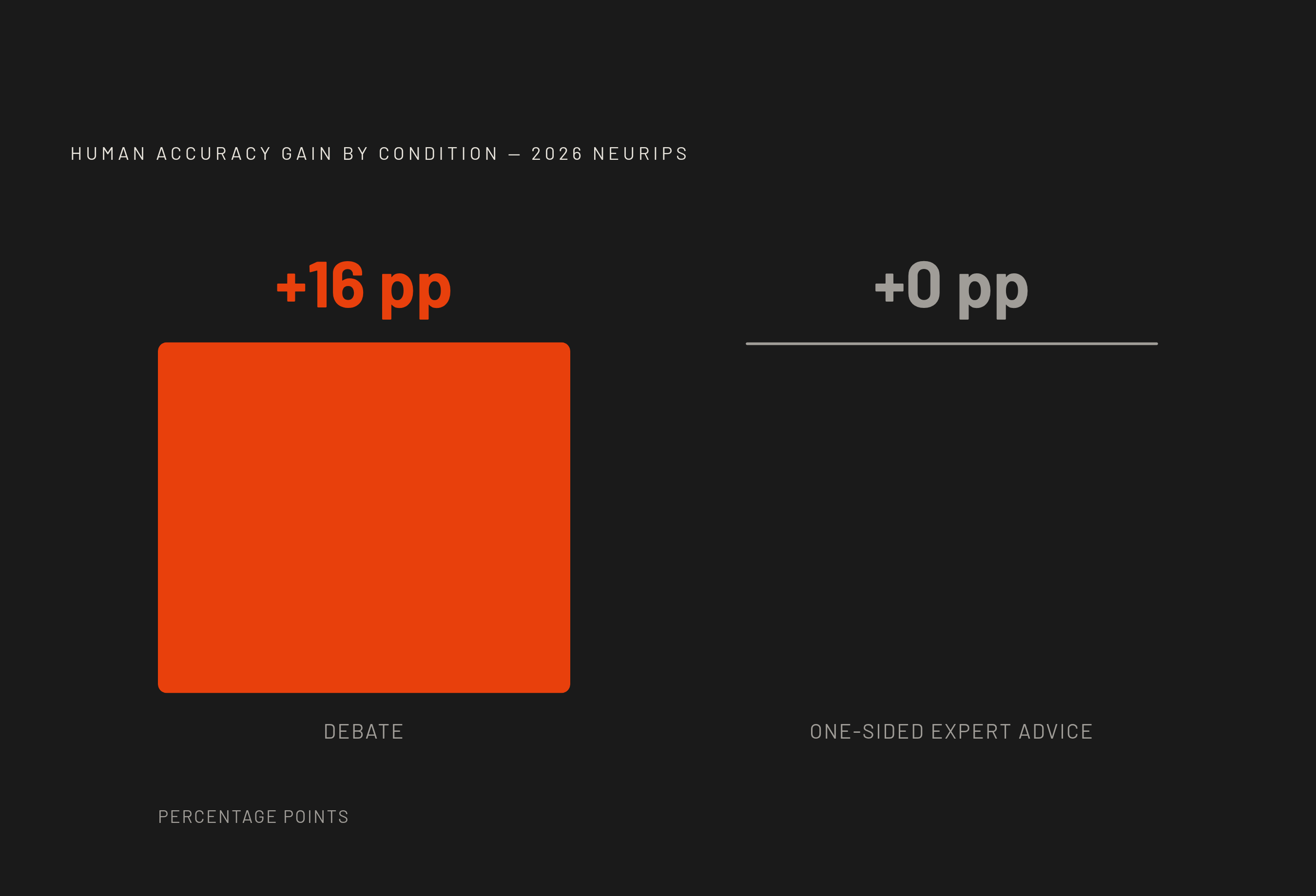
AI judging should be checked before it is trusted. A 2026 NeurIPS paper found that debate raised human accuracy by 16 points, while one-sided expert advice did not help. The same paper found mixed results for weaker AI models judging other AI models, with no comparable gains in most settings and possible reductions in accuracy. That objection is substantive. It concerns model-supervising-model oversight, however, rather than establishing that AI cannot usefully assess human argumentation.
The distinction does not prove that every AI verdict is sound. Fairness depends on the judging structure as well as intelligence. A multi-model panel uses independent judges from different models and produces a verdict only when two agree, recording no winner for a split. With pre-committed criteria, the scoring rules are published before the round. Human appeals add a separate safeguard when either side challenges a decision within the allowed short window, transferring the decision from the original model to a human reviewer.
For the debater, the practical value appears in the written decision. The judge reads the transcript against a published rubric covering claim, support, direct response, comparison, and follow-through, then scores each side and explains the result. The report and speaker points remain on the debater's profile. This makes the decision available for later examination. A verdict that cannot be checked offers little guidance, so its reasons should cite the specific speech that won or lost the point.
The relevant comparison is often informal club feedback. A coach's verbal notes can be uncited, vary across coaches, and address the group as a whole. A written decision tied to the transcript can therefore be more actionable. To read it productively, the debater should revisit the cited passage and compare what was said with the criterion applied. The score identifies the result, but the explanation identifies the work.
Building a real practice habit: from first solo round to live opponent
The first step is solo rounds that build argument structure and rebuttal technique before the debater has to use them against a live opponent. The debater chooses the topic and side, and feedback right after a round helps them build on it in the next attempt. Progress needs a visible measure. The guide recommends looking for claim, support, assumption, and response to objection in the debater's own speeches. Praise from the AI is not a substitute for finding those elements in the transcript.
The steelman habit provides a bridge to live opposition. Before answering, the debater restates the other side's argument in its strongest form. This prevents practice from becoming a sequence of victories over weakened objections. It also makes the response more exact. A rebuttal must then confront the opposing case rather than a version stripped of its strongest support.
The transition to live 1v1 should follow consistent structural performance, even while the debater feels less than completely ready. Clear claims, direct responses, and explicit comparison between arguments provide observable evidence that the foundation is present. A live opponent adds their own priorities, unexpected lines of argument, and time pressure that cannot be paused. The guide frames this as moving from rehearsal to participation.
Public play can follow as an optional further stage of participation. A leaderboard rank can mark competitive standing, while the transcript still shows which parts of the argument need work. Creator matchups provide a possible destination with uncertain access. Each stage can be entered on the debater's own timetable. For introverts, that changes progression from a demand for social confidence into a sequence grounded in demonstrated skill.
What solo practice cannot replace, and why that is not an argument against starting
Solo practice has limits in preparing debaters for tournament pressure, nonverbal reading, and experience with in-person judging. An AI exchange cannot supply every demand of facing another person in a competitive setting, and a written score cannot recreate the full experience of an in-person decision. A debater who wants those skills will need to practise in those settings at some point. Their absence leaves open whether foundational practice should begin now.
For someone deterred by club participation, the relevant alternative may be no active practice at all. Watching debates, reading argument guides, and attending meetings without speaking do not provide the same test as constructing a case against resistance and receiving a score. Debate training is closer to chess training than classroom discussion in that respect. An opponent and a result give the attempt consequences. Solo AI rounds can offer both without the debater having to join an institution.
That access broadens who can begin serious practice. A well-funded team or a school with an experienced coach need not be the gateway to repeated argument testing with transparent feedback. The skills developed through those rounds can then transfer to competitive formats, where additional demands sharpen them. Fifty scored solo rounds represent preparation that waiting for the right social setting does not. When a live opponent finally arrives, those reps are already invested.