The Difference Between Someone Agreeing With You and a Judge Actually Evaluating Your Argument
November 24, 20268 min read1,855 words
Text: Share a Hot Take Editors
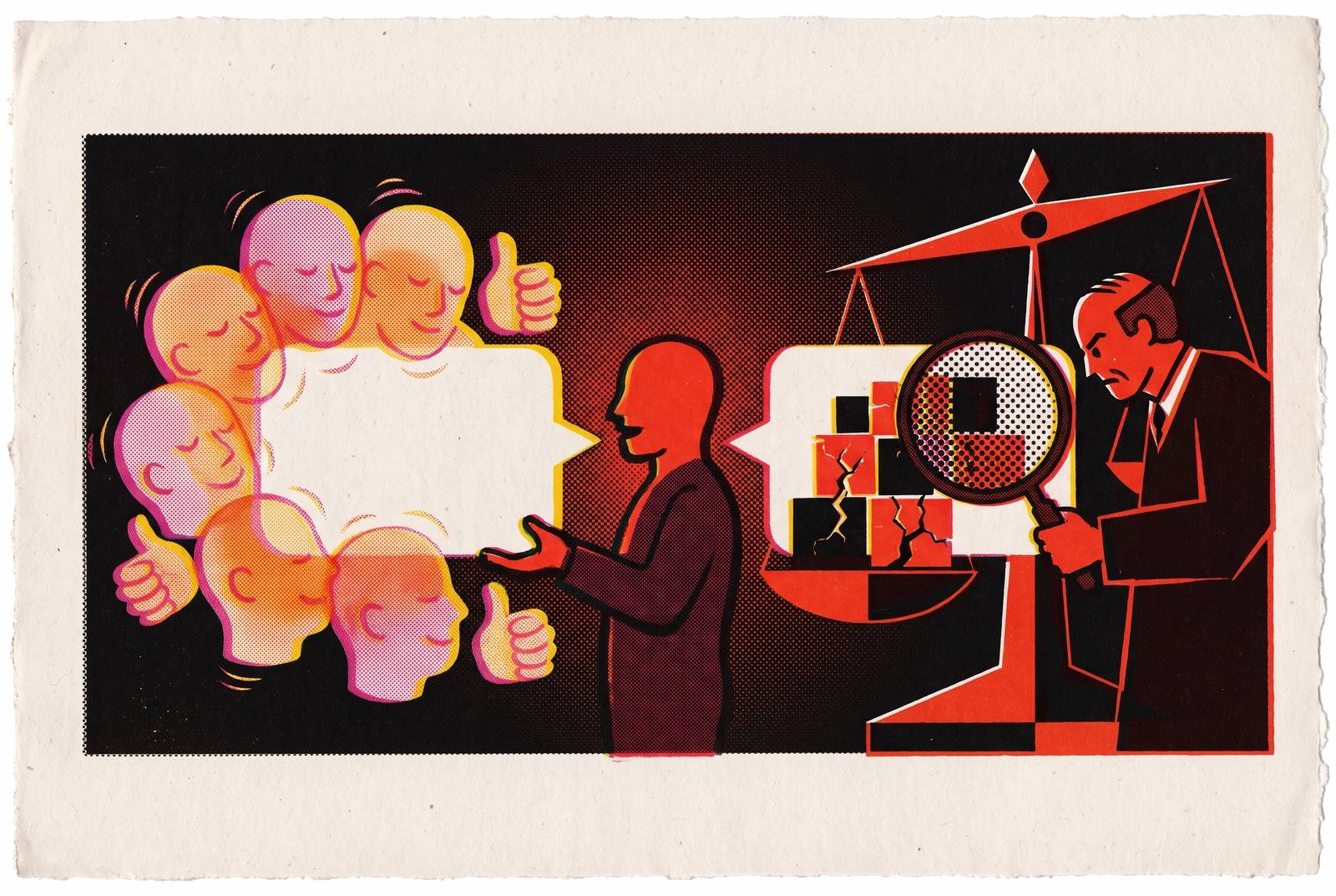
Applause reports belief, while a judge's decision tests your reasoning.
For someone with no competitive background, a debate practice platform should provide a shared question, equal speaking time, and a written decision explaining which arguments held and why. That structure supports practice without joining a club. Agreement reports a prior belief, while evaluation tests the reasoning independently of whether the conclusion is welcome.
Why agreement and evaluation feel the same but are not
Someone sides with a proposal, and its author reasonably takes that response as encouragement. What remains unclear is what earned the support. The listener may have followed the reasoning, tested its assumptions, and found the conclusion justified. Or the listener may already have agreed with the conclusion and accepted whatever argument was offered to defend it. The same outward response can conceal two different processes.
Confirmation bias makes it hard to spot that confusion. People encountering arguments on subjects about which they already hold views tend to give more weight to reasoning that supports those views. A familiar conclusion can make a weak connection seem persuasive, while an unwelcome conclusion can make sound reasoning seem suspect. Approval may therefore establish only that the conclusion found a receptive audience.
This distortion affects the speaker as well as the listener. People generate arguments for claims they already hold, then encounter audiences who judge those arguments through their own prior beliefs. The exchange can reward agreement over reasoning even when neither side is trying to avoid having its arguments tested. The practical difficulty is that confidence can increase without any corresponding improvement in the case. So what does genuine evaluation actually require?
What genuine evaluation requires, as formalized by competitive debate

Competitive debate turns evaluation into distinct tasks that a judge must perform regardless of personal sympathy. Its basic unit is a claim-warrant-impact chain. The claim states what is true, the warrant explains why it is true, and the impact establishes why it matters. Each part has a separate job to do. Without the full chain, the judge has only a position to accept or reject and lacks a complete argument to evaluate.
The warrant is where agreement most readily substitutes for evaluation. A listener who already accepts a claim may not demand the reasoning that connects it to its support. A judge must examine that connection anyway. The impact then poses another question, which is what follows if the claim holds. Establishing that something is true does not, by itself, establish its importance to the decision.
In policy debate, the affirmative bears a burden of proof across topicality, inherency, significance, harms, and solvency. Failure to establish any one can justify a negative ballot. In parallel, the burden of rejoinder requires a debater to answer an opponent’s reasoned argument. A judge may treat an unanswered argument as conceded, regardless of the strength of unrelated arguments.
The choice of standards is also open to argument. British Parliamentary judging guidance requires judges to adjudicate which criteria should govern the round. That rule constrains the judge as well as the speakers. Evaluation includes deciding whether the proposed basis for comparison has been defended.
How can someone with no debate experience practice this outside competitive rounds?
The same duties apply when a colleague makes a claim that someone disputes. If someone asserts that a project will fail without a proposed fix, that person must demonstrate the causal link. The assertion alone does not establish the dependency. The other side has no obligation to disprove a claim that has not been supported. Demanding that disproof instead is shifting the burden of proof.
A problem-solution document faces much the same test. Its account of the problem corresponds to harms, its explanation of why the problem persists corresponds to inherency, and its case for the proposed remedy corresponds to solvency. The formal labels are not needed to apply those questions. A reader can distinguish an established problem from an unsupported explanation of its cause. The reader can then assess the remedy without treating concern about the problem as proof that the remedy will work.
For someone practicing without a club, this provides a workable written framework. The exercise is to state the claim, expose the warrant, explain the impact, and answer the strongest objection. No competitive vocabulary is required to do that. The focus shifts from how convincing a position sounds to whether its connections hold up when challenged.
Those connections often bring to light premises that neither side has stated. Most real disagreements turn on such premises. Some concern facts that evidence could resolve, while others concern values that more factual evidence cannot settle on its own. Identifying the kind of dispute comes before choosing its end state. Otherwise, the exchange demands factual convergence from people who disagree about what should count as desirable.
What a written judge decision produces that an audience reaction cannot
A written judge decision identifies the crux, which is the specific point on which the result turns. It explains why that point outweighs other considerations, independently of which side the judge finds more sympathetic. The decision therefore has a location within the argument. It shows which reasoning did or did not earn the judgment that one speaker was more convincing.
An explained decision also distinguishes shared ground from contested ground. That distinction makes it possible to say what would have needed to change for the outcome to differ. If a necessary causal link was not established, the decision can locate the failure in that specific part of the case. An audience must test the argument as well as approve of it to explain where it succeeded or failed.
The most difficult discovery may concern a definition. Two people can appear to dispute the truth of a claim while using a central term differently. A structured evaluation makes that divergence explicit, so the disagreement no longer appears to be an unexplained refusal to accept the same facts. This need not yield a clean winner. Knowing precisely where the reasoning separates is a productive outcome in its own right, distinct from either consensus or victory.
Why online arguments rarely produce evaluation and what changes that
Online arguments often lack three structural conditions for evaluation. There is no shared question, no equal speaking time, and no agreed mechanism for ending the exchange. Without a common question, each participant can keep defending a different claim. Without equal time or a defined ending, repetition can continue until someone leaves. When someone leaves, the exchange ends without a decision on whether either case held.
Participants perform for onlookers whose approval may reflect existing beliefs. The incentive is then to produce the stronger display. More applause can reproduce the original confusion between being agreed with and being evaluated.
Moving a disagreement to a private channel removes the crowd whose approval rewards performance. Steelmanning then requires each participant to reconstruct the strongest version of the opposing argument before responding, serving the same purpose as the burden of rejoinder. The objection must be addressed in its actual form. Treating a changed mind as progress supports that work, and this reframing is learnable.
A structured round directly repairs the three missing conditions. One motion establishes what both sides will debate, a clock for both sides provides equal speaking time, and a written decision supplies the agreed ending. These are concrete criteria for a debate practice platform, including one intended for people without competitive experience. They replace an open-ended exchange with a bounded reasoning task. The feedback can then explain where the case succeeded or failed instead of merely recording which side attracted support.
How AI judges attempt to replicate formal evaluation and where they still fall short
The LLM-as-a-judge paradigm attempts to apply explicit evaluation criteria at scale. Its premise is that a model can score reasoning. An AI verdict is useful only insofar as the process separates the quality of the argument from the attractiveness of its conclusion.
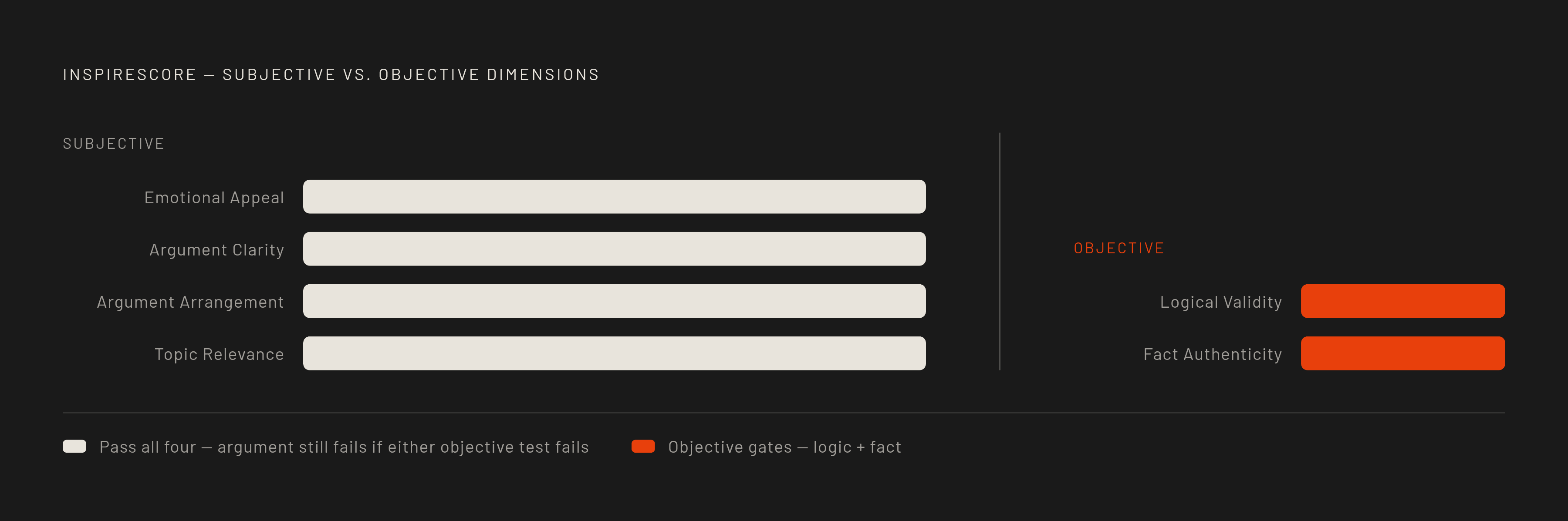
The InspireScore framework (ACL 2025) scores arguments across six dimensions. Its four subjective criteria are emotional appeal, argument clarity, argument arrangement, and topic relevance. Its two objective dimensions are logical validity and fact authenticity. An argument can appeal to a listener while failing either test.
The D3 framework (EACL 2026) assigns a judge to provide structured, criteria-based feedback on relevance, accuracy, depth of analysis, clarity of expression, strength of reasoning, and effectiveness in addressing opponent's points. Advocates argue each side in parallel, and a jury judges the arguments on its own. This courtroom-inspired architecture is designed to prevent one agent’s bias from determining the result. The safeguard is a distribution of roles. It does not depend solely on asking one model to be impartial.
The objection is that models can reproduce the distortion they are intended to replace. RLHF-trained models exhibit sycophancy, aligning with user beliefs even when those beliefs are false, because preference training rewards agreement over accuracy. Other known ways these models fail include position bias, verbosity bias, and authority bias. These favor, respectively, answers presented first, longer and more confident responses, and answers augmented with fabricated citations and scholarly language. None establishes that the reasoning is stronger.
Mitigation research combining position-swapping, chain-of-thought prompting, and explicit rubrics has helped address position bias. Current research also finds that position bias is already negligible in modern models, while mitigation results depend on the model. Verbosity bias and sentiment bias are still concerns.
Multi-agent architectures using diverse advocates show strong agreement with human-majority verdicts. However, that agreement does not establish resistance to deliberate manipulation. A benchmark that cannot be interrogated is marketing rather than a sufficient basis for trust, and AI judges should be stress-tested publicly. Whether the judge can preserve its evaluative standards at scale when participants deliberately try to divert it from them remains unresolved.
Why transparency about how a judge decides is what separates evaluation from performance
Answering that question requires access to the basis of the decision. A judge that says “side A wins” without explaining which arguments held produces an outcome that functions like preference. The reader cannot interrogate the decisive inference, correct a mistaken premise, or learn why the opposing case failed. An unexplained verdict conceals the distinction under examination. It could reflect evaluation, agreement, or a bias that the result alone cannot reveal.
University Interscholastic League’s 2026 CX judge instructions require an argument to be extended across every relevant speech and weighed at the end of the round. That requirement makes the evaluative chain visible. The judge can then explain where it held or broke. Transparency begins with the reasoning presented.
The same standard applies to an AI judge. A score without its reasoning, caveats, and known failure modes leaves the user unable to assess the process behind it. Human judges also disagree, so matching a verdict cannot be the sole test of genuine evaluation. Their disagreement reflects real variance in judgment rather than a mechanical process with one inevitable output. Written rationales make those differences available for examination, while public stress-testing exposes whether the process withstands attempts to manipulate it.
A human judge at a tournament, an AI on a structured platform, or a written framework applied to a person’s own reasoning must make the decisive connections available for scrutiny.
Sources
- Multi-Dimensional Subjective-Objective Evaluation-Guided ...
- Debate, Deliberate, Decide (D3): A Cost-Aware Adversarial ...
- Speech and Debate — University Interscholastic League (UIL)
- InspireDebate: Multi-Dimensional Subjective-Objective Evaluation-Guided Reasoning and Optimization for Debating
- Can LLMs Judge Debates? Evaluating Non-Linear ...
- How to be a great debate judge Guidance for first time PF, LD and Policy judges
- N AT I O N A L S P E E C H & D E B AT E A S S O C I AT I O N Judge Paradigm
- Benchmarking LLM Judges via Debate Speech Evaluation