The Exact Sequence of Events Between Opening an App and Reading a Judge's Verdict on Your First Argument
November 16, 20268 min read1,868 words
Text: Share a Hot Take Editors
Follow one debate round from topic pick to scored verdict.
A live debate practice app gives people with no competitive background a structured way to argue against an opponent and receive scored feedback without joining a club. The sequence runs from topic selection through fixed speech slots to a written judge’s verdict. Understanding that sequence removes the uncertainty of the first round, while the verdict identifies what to work on in the second.
What actually happens inside a live debate app before you say a word
When you open the app, the first decision is a topic. The system presents resolution options or lets you choose, and the round cannot begin until both sides have a position. Nothing needs to be argued at this stage. The immediate task is to establish the claim under dispute and which side each participant will defend.
The opponent can be another person matched in real time or an AI opponent in a solo round. These routes serve different practical needs. Human matching provides a live exchange with another user, while the solo option allows practice without waiting for a match. The choice changes who responds to your arguments, but both routes lead to a judged round. For someone without a team or club, that distinction provides access to an opponent and an assessment in the same setting.
Much of the first-round anxiety comes from uncertainty about what the app will ask next. The sequence makes those demands visible. Topic selection establishes the dispute, the speech structure determines when each participant speaks, and the published judging criteria explain how the exchange will be assessed. The user works through these tasks one at a time.
How a topic gets chosen and what makes a resolution arguable in a timed round
The topic screen shows resolutions that are meant to give both sides a chance. A good topic should split opinion roughly in half, have no obvious answer and give both sides real evidence to use. A resolution with only one plausible answer would test agreement.
Specificity keeps the contest within the available time. “Should schools ban smartphones during class hours?” asks both sides to address the same policy in the same setting. “Is technology good or bad?” leaves the subject so broad that the exchange can become a dispute about definitions before either side establishes a case. The narrower question provides a common target. Its yes-or-no form also makes the eventual decision binary and checkable against the resolution.
For a first round, the practical selection rule is to choose the side with more accessible evidence. Conviction is not a substitute for support. A debate turns on evidence and rebuttals, so a position that feels personally natural may still be harder to defend within the round. Arguing the side you disagree with can build more skill because you have to find support.
The structure of a round: what each speech slot asks you to do and in what order
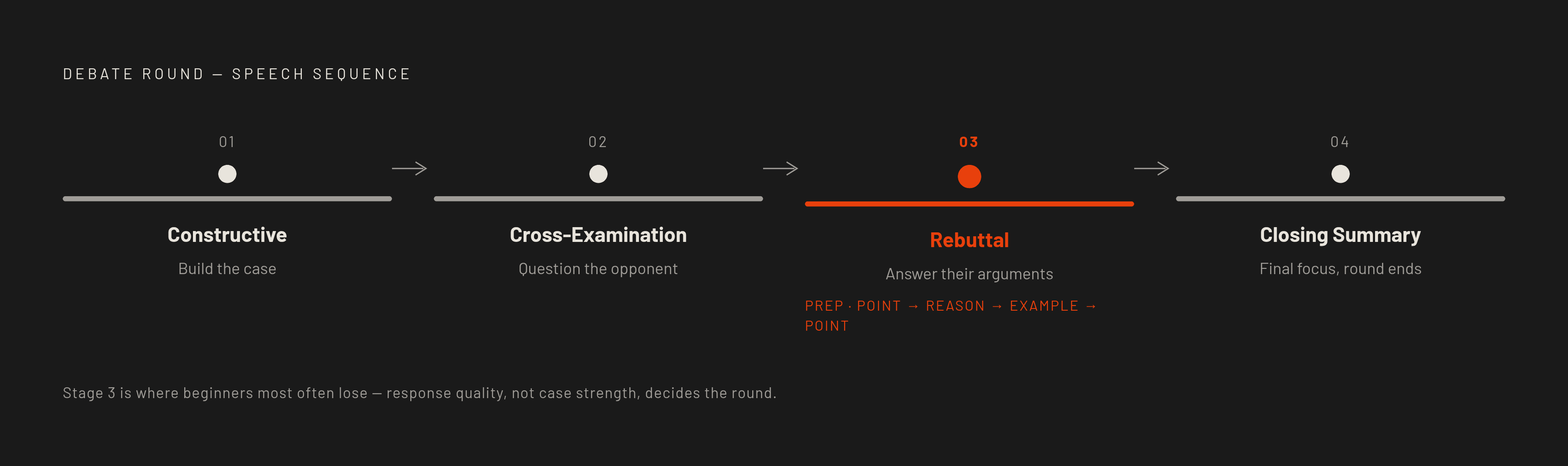
The round starts with constructive speeches, in which each side establishes its case on the resolution. Cross-examination comes next, when each person gets a turn to question the other side’s case. Rebuttals then address what the opponent has argued, before a closing summary or final focus brings the exchange to an end. Each slot has a separate job. Knowing that order removes the need to decide what kind of contribution belongs at each turn while also deciding what to say.
Rebuttal is the clearest change in task. Rather than adding another independent claim, the speaker must respond directly to the opponent’s argument. PREP, which stands for Point, Reason, Example, Point, gives that response a compact structure. It distinguishes a supported answer from a statement of disagreement. In this part of the round, the question is not simply whether a case sounds plausible, but whether it withstands the challenge actually made against it.
The exchange can also include points of information, or POIs, during a speech. The opponent may interject, and the speaker may accept or decline. The AI opponent does this at sub-200ms latency, reproducing the pressure of an interruption in a live tournament round. Across these slots, steelmanning means stating the opponent’s position in its strongest form before contesting it. Judges read that as command of the issue because the response addresses the strongest counterargument. The closing summary or final focus completes the sequence, and the final speech ends.
What the AI judge is doing while you speak and why the structure produces a fair verdict
While the speakers argue, the judge compares their cases based on the claims they actually make. The judge can assess whether one participant exposed a gap in the other’s reasoning and whether that gap received an answer. The opponent supplies part of the scrutiny, making the adversarial exchange a mechanism for testing arguments.
Geoffrey Irving, Paul Christiano, and Dario Amodei proposed this approach at OpenAI in 2018 as a way to supervise AI through debate. The central insight is that identifying a flaw can be easier than producing the correct answer independently. An opponent seeking to win has a reason to expose that flaw. Tests with language model judges found that both model and human judges were more accurate after reading a structured debate than with naive baselines. That supports using judges to compare cases, but it does not prove that they will get every verdict right.
The transcript gives this comparison a defined record. A decision must refer to what the participants actually said, rather than crediting an argument that never appeared in the round. This audit trail makes quotations and descriptions of the exchange checkable, while the opposing participant’s challenges help test the claims within it.
The published judging qualities include logic, response quality, clarity and persuasion. Because these qualities are shown before the first speech, participants can use them to check the verdict afterward. The panel also draws on three independent models. That reduces the chance that an individual model’s preference, such as rewarding confidence over correctness, determines the decision alone.
The known bias in AI judging and why the panel design addresses it without eliminating it
AI judges have a measurable last-speaker bias. The final speaker can win more often than argument quality alone would predict. This is a limitation of the assessment. A first-time user needs to know about it before interpreting a loss or treating a narrow victory as conclusive evidence of a stronger case.
The bias is not confined to one model. In AI debate tournament data, every judge on the panel favored the final speaker to some degree, although susceptibility varied between models. That pattern points to a broader weakness in how language models evaluate sequential arguments. A strong closing statement can receive disproportionate weight because it comes last, rather than because it resolves the most important dispute.
A three-model panel still has a bias if all three judges share it. Its benefit is more limited and more precise. It reduces the probability that one model’s particular degree of susceptibility controls the outcome alone. The same holds for the documented concern that judges can favor a confident tone over a correct answer. Requiring transcript citations constrains the explanation by making it possible to flag a confident judgment that lacks support in the recorded exchange, but citations do not make the underlying evaluation infallible.
Results are therefore appealable to a human reviewer. The appeal is a structural safeguard for decisions whose reasoning or treatment of the round is disputed. It provides recourse beyond the models that produced the original result.
The moment the verdict appears: how to read a scored decision and what each part tells you
When the verdict loads, within seconds of the final speech, the result includes a written reason for decision, or RFD. Each side receives a score out of 100. The accompanying explanation is designed to show why the score was awarded, rather than leave the user to infer a cause from the total. The number records the assessment of this exchange.
The scorecard connects the result to six axes published before the round, including the argument, responses to the other case, and structure and clarity. Differences between categories locate weaknesses more precisely than the overall score can. A speaker can make a case that is easy to follow yet fail to answer the opponent’s objections. Another can answer those objections but leave it unclear how the evidence supports the conclusion. Those are different problems, even if they contribute to a similar total.
For a first-time reader, the recommended first diagnostic is response quality. This is the area beginners most often lose on, and it indicates whether the speaker engaged the opposing case or talked past it. The reader can then compare logic with clarity. If logic is lower, the presentation may have been understandable while the inferential step connecting evidence to the claim remained unstated. Clear wording cannot supply a missing reason.
The transcript citations then point to the exact lines or claims behind those scores. They show where the judge found an answer convincing, incomplete or unpersuasive, allowing the reader to compare the explanation with the exchange itself. That specificity distinguishes a coaching note from a bare verdict. A completed round can consequently provide more targeted feedback than most classroom discussions, where an argument may receive reactions without a scored explanation. The RFD becomes the starting point for the next round.
What the first round actually prepares you for and why the second round is easier
The first round’s primary function is calibration. It establishes how the user’s argument holds up under questioning, interruption and a requirement to answer another case. The RFD then identifies where that structure broke down. The second round begins with information the first lacked. Instead of facing an unfamiliar process and an undiagnosed weakness at once, the participant knows the sequence and has a specific part of the argument to improve.
Formal debate practice develops dynamic reasoning, strategic thought and cognitive discipline. These involve adapting ideas under pressure, anticipating objections and structuring an argument clearly enough for another person to assess. One round is only a beginning. The relevant analogy is chess training rather than classroom discussion because the practice combines an opponent, a time constraint and a verdict. Exposure to arguments alone does not reproduce the demand to answer them while defending a position of your own.
Access to that kind of practice has historically depended on a well-funded team or institution. Pairing people with an opponent in real time and giving them scored verdicts right away lets them practise without that support. Beyond the first round, the leaderboard provides a progression structure in which winning judged rounds raises rank. Top-ranked users can be considered for live debates with creators and streamers through the creator matchup pathway, though a high rank does not ensure an invitation.
The concrete next step is a second judged round using the first RFD as its reference. A user who wants to debate another person can return to matching and work toward the leaderboard. Someone who wants to practise right away can choose a solo AI round without waiting for an opponent. The AI delivers its speeches by voice and takes POIs mid-speech, while the same judge panel produces a ballot at the end.