
The Persuasion Beginner's Case for Skipping Preparation and Getting Judged First
November 25, 20268 min read1,834 words
Text: Share a Hot Take Editors
A first judged round shows beginners exactly where their arguments fail.
For people with no competitive background, a useful debate practice platform provides structured rounds and written judging decisions with reasons. Entering a judged round before extended preparation is the fastest way to identify what an argument is missing. The first round should function as a diagnostic because its value lies in the specific preparation agenda the decision makes possible.
Why beginners instinctively over-prepare and what that instinct costs them
The impulse to prepare more before being judged is understandable. A beginner wants to know enough to avoid being caught without an answer, so another outline or rehearsal seems like a way to stay safe. Yet preparation cannot simulate an opponent choosing which weakness to attack. Solo work develops the arguments their author already finds convincing, while leaving untested both the arguments they never considered and the responses they will omit under pressure. Confidence in a prepared case is therefore not evidence that it will survive an exchange.
The underlying assumption is that readiness comes before participation. In competitive debate, however, part of readiness consists of predicting, responding to, and adjusting to another person's arguments as the round unfolds. Those are live-round skills. They require decisions about what deserves attention when there is not enough time to address everything. More time spent preparing puts off the first chance to find out which of those decisions a beginner gets wrong.
A formal competitive debate divides that work across opening, rebuttal, and closing. Within those stages, speakers allocate limited time to new claims, support for existing claims, attacks, and responses to attacks. A beginner may prepare a lot of material without knowing whether they spend too long making claims and too little time defending them. The cost is delayed practice and preparation directed by assumptions about weaknesses.
What a written judging decision reveals that a practice session cannot
A written decision with reasons identifies a failure at the point where it affected the result. It can distinguish an unsupported claim from a claim whose evidence was supplied but whose reasoning remained incomplete. That distinction changes the next preparation task. More evidence will not necessarily repair a missing warrant, which is the reasoning connecting evidence to the claim. A decision that names the missing connection gives the beginner a narrower and more useful problem than a general instruction to be persuasive.
In most competitive formats, an argument that receives no response is treated as true for the rest of the round. A speaker may have had an answer available but failed to deliver it when the exchange required one. Solo rehearsal cannot reveal that omission in advance. The written decision can show that the problem was not a shortage of ideas but a failure to answer the opponent's actual point.
A speaker can also claim an impact without doing enough to weigh it against the opposing case. Here, the decision can explain why establishing a consequence did not establish that it should determine the result. A practice session may show whether a case makes sense on its own, but a judgment with reasons explains how it stood against another case. That makes the written explanation a different source of information from the beginner's own impression of how well they spoke.
The structural gaps a beginner's first round will almost certainly expose
A missing warrant leaves a basic gap in how an argument is built. Beginners can make a claim, give an example, and move on without explaining why the example supports the conclusion. The connection feels obvious to its author. A judge's explanation makes that private assumption visible by identifying the step the audience was asked to supply.
An unmet burden of proof is related but distinct. Whoever makes a claim must support it, and the affirmative or proposition side bears that burden for the resolution as a whole. An opponent's weak response does not itself supply the missing support. Beginners may discover only through a written decision that they never established what they needed to establish.
Some formats make these obligations especially explicit. In the Stock Issues framework, the affirmative must win Topicality, Significance, Inherency, Solvency, and Harms, so dropping one can decide the round. Inherency names the barrier in the status quo that keeps the plan from already being in place, whether structural, attitudinal, or existential. Beginners can skip it because it sounds technical. When a judge points out missing inherency, the beginner can see exactly what the case lacked through a term they did not know.
Other gaps become visible only through interaction. Active listening requires processing what the opponent actually argued before formulating a response, rather than answering a nearby point that is easier to rebut. Preparation alone does not test that distinction. A decision can reveal that an apparently forceful response never addressed the claim it needed to defeat. This is why early judgment provides information that another revision of the opening cannot.
Why the structured format of the round is what makes the feedback usable
An argument with a friend can produce disagreement without producing a diagnosis. Without equal time, direct response requirements, and an explained decision, there may be no shared basis for identifying why either side prevailed. Online exchanges compound that problem when volume and notifications replace direct engagement. A structured round makes answering the other side part of the task.
For a beginner, those constraints reduce ambiguity. Equal time puts both sides on the same clock, while rules that require a response show whether a rebuttal answers the argument actually made. A structured refutation identifies the opponent's point, states the response, and explains its reasoning. The opponent supplies the part rehearsal cannot reliably provide. Without that constraint, a beginner can repeatedly practise against objections they already know how to answer.
Conch: Competitive Debate Analysis via Visualizing Clash Points and Hierarchical Strategies examines how disagreements and strategies develop and interact over a debate. An argument's role depends on what precedes and follows it. Tracking the round preserves that context for analysis. SPAR, or Spontaneous Argumentation, offers a low-preparation entry point by retaining a resolution, a clock, and a decision while requiring debaters to argue a resolution they have not prepared in advance.
How to read a loss as a dataset rather than a verdict on your ability
A loss with a written reason is information. A win without one is noise for diagnosis. The loss provides an account of where the case broke down, while the unexplained win supplies no comparable basis for deciding what to retain or change. Neither result establishes a beginner's ability in general. A first round is therefore better judged by whether the speaker made a complete, structured argument on each major point than by whether the judge gave them the win.
That standard gives a debrief something concrete to examine. The relevant questions concern which argument decided the round, whether adaptation to the judge was adequate, and what cross-examination could have established more effectively. A record of those answers allows patterns of strengths and weaknesses to emerge across rounds. One omission is a data point. Repeated omissions provide a stronger basis for deciding where preparation should go.
TreeDebater uses tree-like structures to look ahead to attacks and defenses and keep track of which arguments are still active during a debate. A beginner is learning to distinguish points that were answered from points that remain standing, rather than treating the round as a sequence of speeches. The practical next step is deliberately narrow. Read the decision, name the two specific gaps it identifies, and make those the only preparation agenda for round two.
How can an AI judge give useful feedback without debate experience?
AI judging offers a practical route for beginners without access to a coach or competitive circuit, and its useful feature is the explanation. A good decision distinguishes argument strength and relevance, coherence and organization, and style and tone. Otherwise, a beginner cannot tell whether the next task is to strengthen the reasoning, reorganize the case, or change the delivery. The explanation must connect its assessment to what occurred in the round.
That requirement also makes the judgment open to scrutiny. If the judge says an argument went unanswered, the beginner should be able to trace that conclusion to the exchange and consider whether it is justified. The verdict alone provides no such opportunity. Human chair judgments are valuable, but human judges disagree too, so agreement with a human is not an absolute guarantee of correctness. The useful standard is a written decision the beginner can reason about, challenge, and use to identify the decisive point.
AI judging also has systematic failure modes, even when the explanation reads well. Position bias can favor a position, verbosity bias can reward a longer argument however good it is, and self-preference bias can favor outputs from the judge's own model family. These are not merely concerns about an occasional wrong winner. They can misdirect learning by rewarding features unrelated to the strength of the argument. A beginner who gets that feedback may take what the judge likes to be a skill they should build.
For that reason, how open a debate practice platform is should help guide the choice of where to practise. Failure modes should be published openly with caveats, and benchmark claims should be available for scrutiny. An opaque benchmark is marketing. Structured rounds make the reasoning easier to check because equal time, direct response, and a decision with reasons give the beginner a clear exchange to check it against.
The minimum viable first round: what to bring, what to leave behind
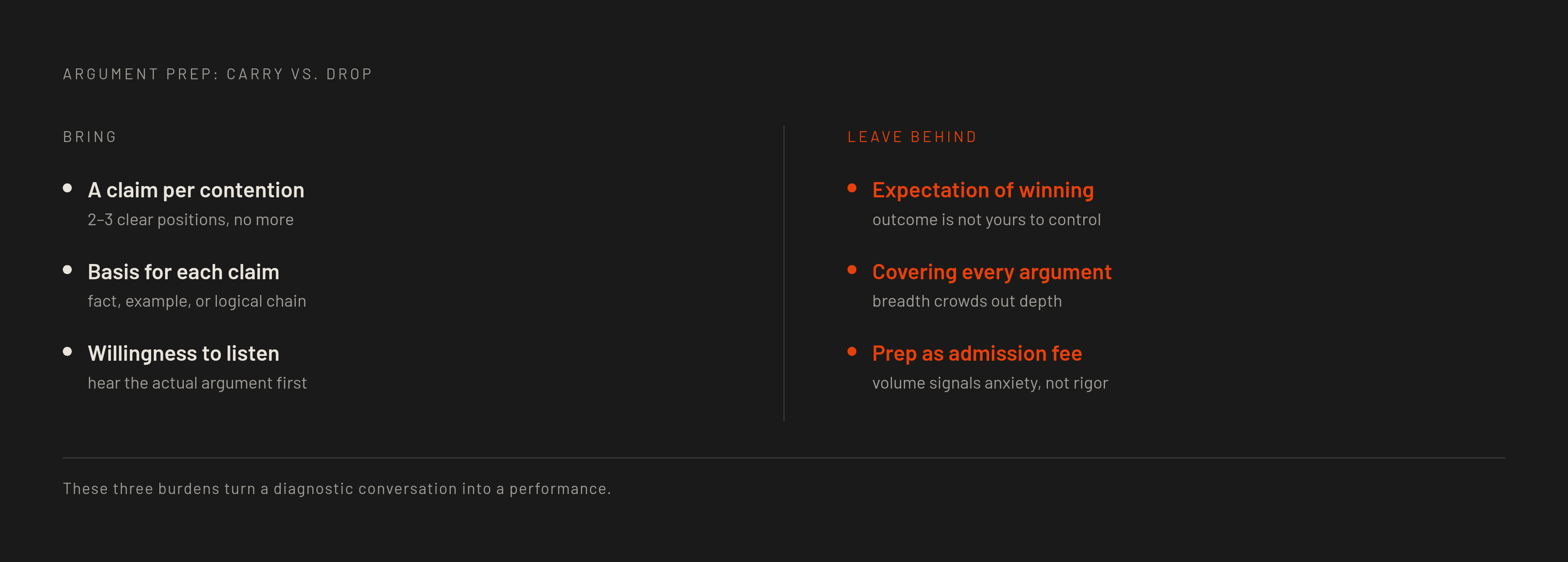
For a beginner ready to start, the minimum is a resolution, equal speaking time, a mechanism for direct response, and a decision with reasons. That does not require a coach or years of experience. A restricted-preparation format such as SPAR also removes the expectation of advance research. Its purpose is not to make subject knowledge irrelevant, but to let the exchange begin before preparation becomes a barrier. The round supplies the conditions under which weaknesses can become visible.
The appropriate starting material is modest. Bring a clear claim on each of two or three contentions, some basis for each claim in a fact, example, or logical chain, and a willingness to hear the opponent's actual argument before responding. Familiar contested topics, including tipping, phones in schools, canceled plans, and remote work, can keep the first attempt focused on argument structure. Existing opinions are enough to begin testing the reasoning behind them. They are not a guarantee that the reasoning will hold.
What should remain outside the round is the expectation of winning, the ambition to cover every possible argument, and the belief that extensive preparation is an admission requirement. Each turns the diagnostic back into a performance. The next step is to enter the structured exchange and use its written decision to focus preparation on addressing the two identified gaps. The first decision is the first real preparation agenda. Everything before it is guesswork about what the beginner most needs to fix.